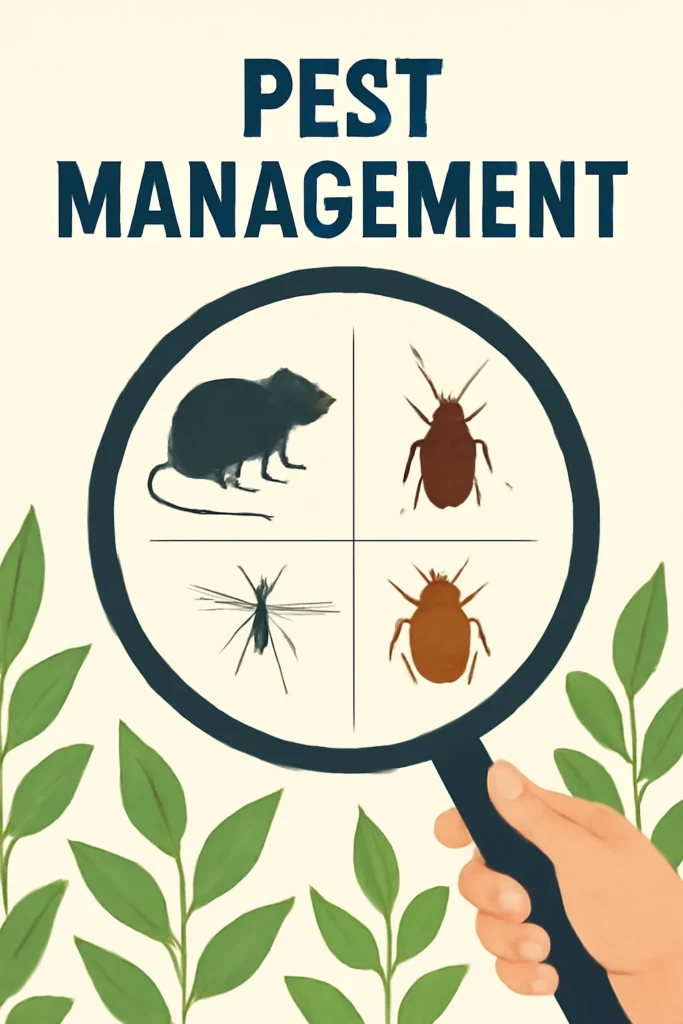
What Is Pest Management
Pest management is a process of action against pests that cause significant harm to humans or the environment. Definition of Pest Management Pest management refers to the process of controlling, reducing, or eliminating unwanted organisms—called pests—that negatively impact human life, property, crops, or the environment. These pests include insects, rodents, weeds, fungi, and others. This field includes identifying pests, comprehending their behavior, and applying secure and efficient control techniques. Balance, safety, and long-term efficacy are key components of pest management beyond simple eradication. Pest Control Definition vs Pest Management Control There is a slight distinction between what is intended by pest management and pest control, even though the phrases are sometimes used interchangeably. Pest Control Definition Pest control definition usually refers to the immediate action of eliminating pests using tools such as pesticides, traps, and extermination services. It’s often reactive, meaning it addresses pests after they appear. Pest Management Control Pest management is a thorough and effective way to keep pests away and keep them under control. It uses many different techniques, such as biological, chemical, mechanical, and cultural ones, all of which were carefully picked to have the least amount of negative effects on people’s health and the environment. Define Integrated Pest Management (IPM) Now that we’ve explored the general concept of pest management let’s turn our attention to one of the most significant advancements in modern pest control: Integrated Pest Management (IPM). Define Integrated Pest Management A sustainable, science-based method of managing pests is integrated pest management, or IPM. It integrates several economically and environmentally sound control methods to control insect populations below harmful levels and lessen the need for chemical pesticides. IPM Integrated Pest Management Philosophy A paradigm of integrated pest management (IPM) places more of an emphasis on long-term prevention than it does on short-term solutions. It emphasizes. This approach is common in agriculture, horticulture, public health, and residential settings. Integrated Pest Definition Integrated pest definition refers to using multiple methods—biological, cultural, physical, and chemical—to control pests in an effective and environmentally friendly way. The objective is to employ the least detrimental strategy required for control, minimizing risk to non-target species, aquatic resources, and human health. Key Principles of IPM Pest Control For pest control, the following is a list of some of the essential principles and approaches that come under the umbrella of integrated pest management (IPM): 1. Identification Precise pest identification is crucial. Misidentifying a pest may result in unsuitable treatment and exacerbated damage. 2. Monitoring Monitoring pest activity using traps and inspections helps identify patterns. This cuts pesticide waste. Threshold Levels Pest presence doesn’t always require action. IPM defines threshold levels—the point at which pests cause unacceptable damage and need control. Control Methods IPM emphasizes four types of control: A. Cultural Controls Cleaning or farming methods could be changed to keep pests away, like locking food bins at home or switching crops around on the farm. B. Mechanical Controls Traps, barriers, or manual removal methods. C. Biological Controls Aphids, for example, can be controlled by introducing ladybirds, natural predators or parasites. D. Chemical Controls (IPM Pesticide Use) IPM pesticide use is selective and minimal when needed. It’s only used after other methods have failed or in emergencies. Explain Integrated Pest Management in Agriculture In farming, IPM reduces damage while preserving pollinators and beneficial insects. Farmers might: Explain Integrated Pest Management in Urban Settings For homes and cities, IPM strategies include: What Is Integrated Pest Control in Canada? It’s a synonym for IPM, especially in industrial or governmental settings. Canadian provinces promote IPM as the best way to handle pest threats while protecting public health and the environment. Government agencies encourage IPM pest approaches in: Define Pest Control in Simple Terms Let’s define pest control: Minimizing or eliminating pests using physical, chemical, or biological means. Examples include: While effective, traditional pest control often lacks the long-term strategy that IPM pest control offers. Integrated Pest Control Definition for Educational For students or beginners, the integrated pest control definition can be explained as follows: A method of controlling pests by combining different techniques (like using natural enemies, traps, or minimal pesticides) to safely and effectively manage pest populations over time. Advantages of Integrated Pest Management Here’s why many experts recommend IPM-integrated pest management: Environmental Protection Minimizes harmful pesticide use and pollution. Economic Savings Targets only the pests that need control, saving money on chemicals and treatments. Human and Pet Safety Cut down on harmful chemical exposure in farms and homes. Long-Term Results Integrated pest management (IPM) permanently eliminates pests by eliminating their causes, not just their symptoms. This method is long-lasting and successful. Challenges of IPM Pest Control Despite its benefits, IPM has some challenges: Requires Expertise You need knowledge of pest behavior, natural predators, and monitoring methods. Slower Results IPM doesn’t always produce immediate results like chemical treatments. Initial Investment Training, tools, and setup may cost more upfront, though they pay off long term. Is IPM Pesticide Use Still Necessary? Yes. Even in IPM, pesticide use is sometimes necessary. The key difference is that pesticides are: This controlled use of IPM pesticide strategies helps avoid overuse and resistance problems. Real-Life Examples of Integrated Pest Management IPM in Canadian Agriculture Canadian farmers use crop rotation, pheromone traps, and cover crops as part of IPM strategies. IPM in Canadian Schools Schools are shifting from monthly chemical sprays to baits, sanitation, and sealing techniques. BP Pest Control and IPM Practices BP Pest Control, a licensed Canadian pest control company, incorporates integrated pestmanagement principles (IPM) into its service plans. From monitoring and evaluation to eco-friendly treatments, it follows IPM to deliver long-term pest solutions that prioritize health and safety. Why You Should Care About Integrated Pest Management Understanding the definition of pest management helps homeowners, farmers, and businesses make smarter decisions. Whether you’re curious about the pest control definition, want to define integrated pest management, or learn how to explain it to others, it’s clear that IPM is the future of safe, sustainable pest control. By embracing IPM