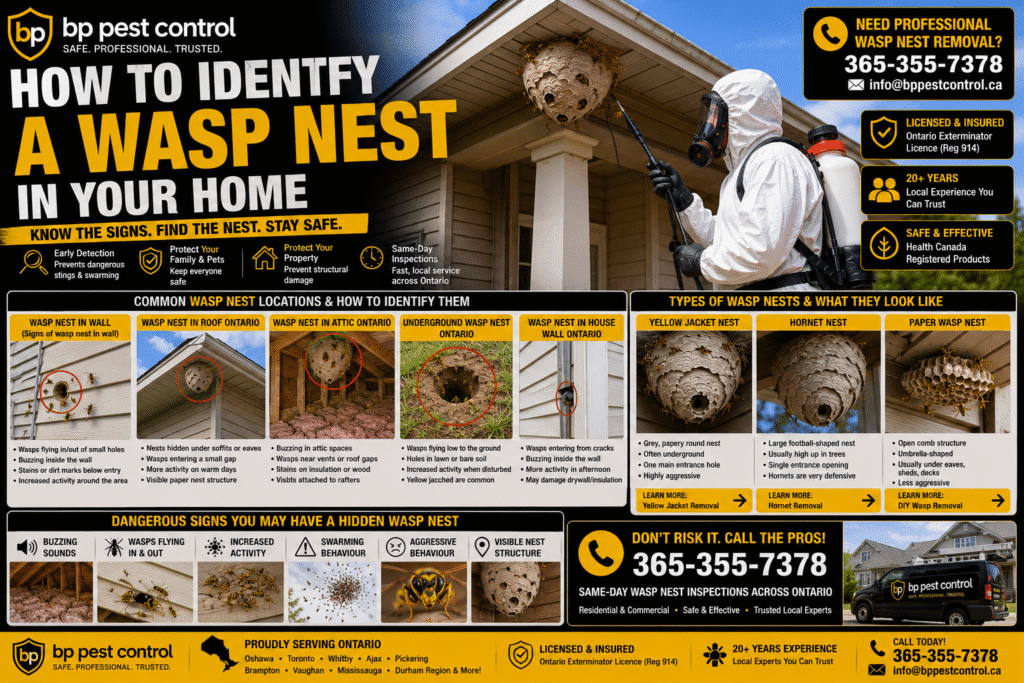
How to Identify a Wasp Nest in Your Home | bp pest control
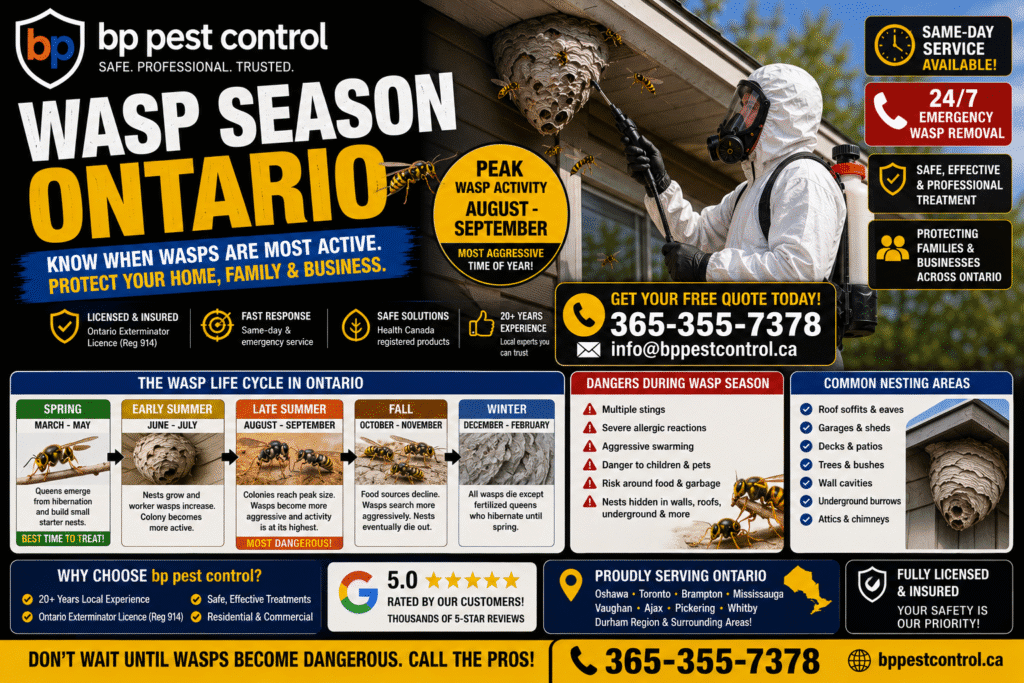
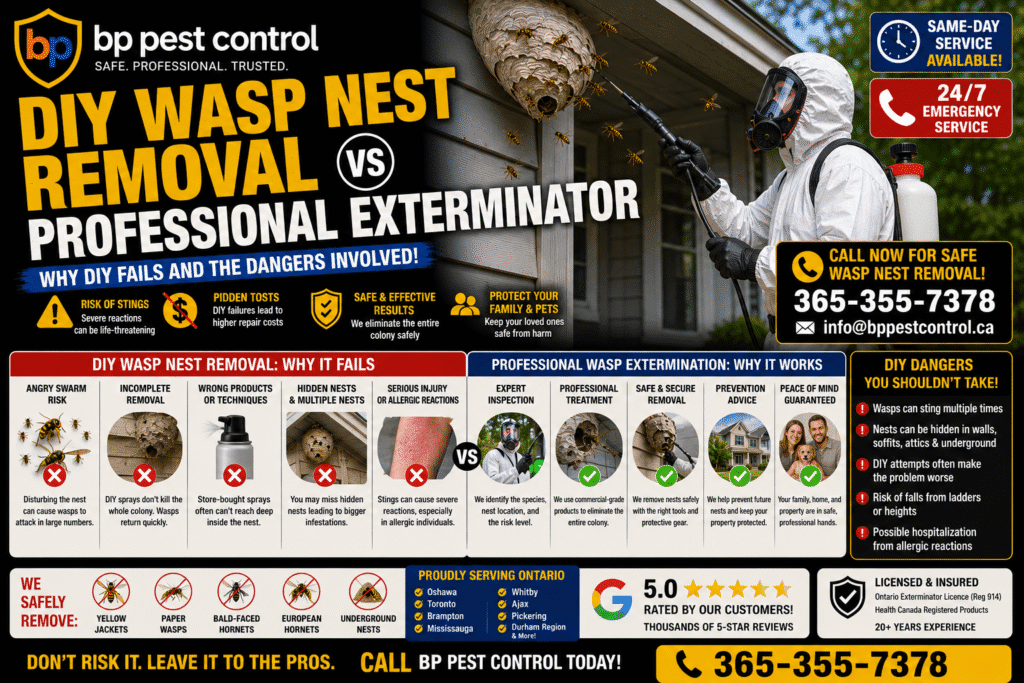
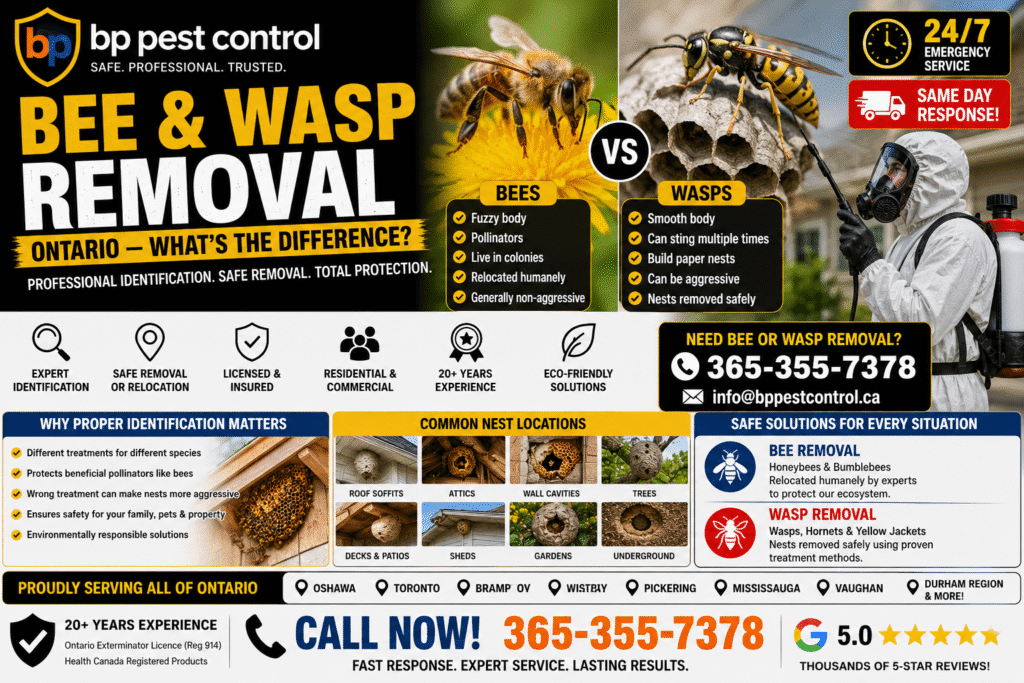
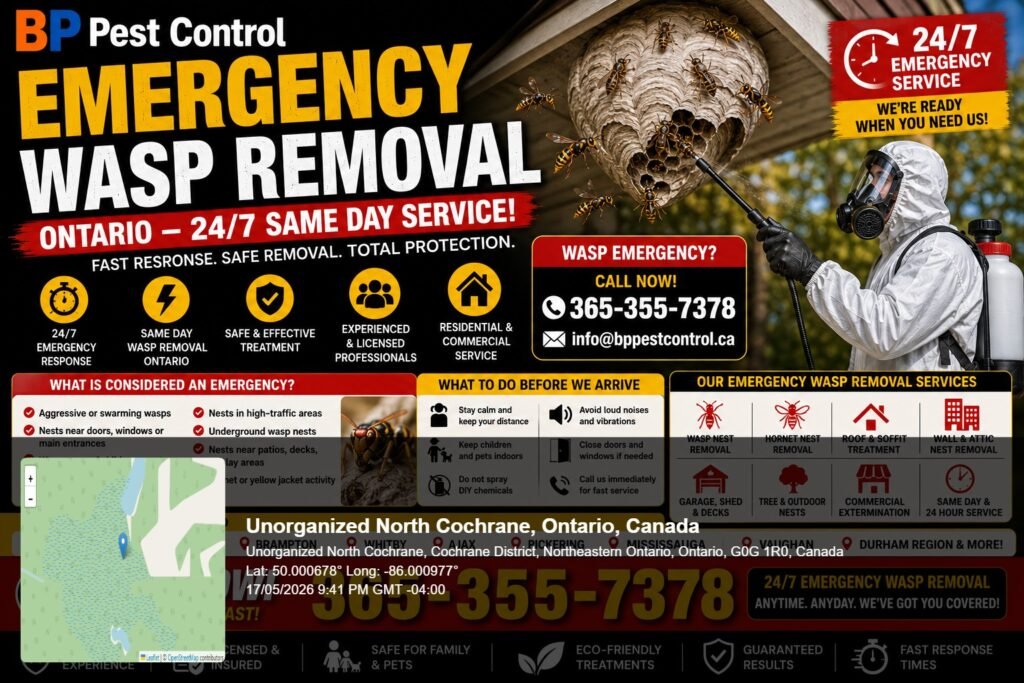
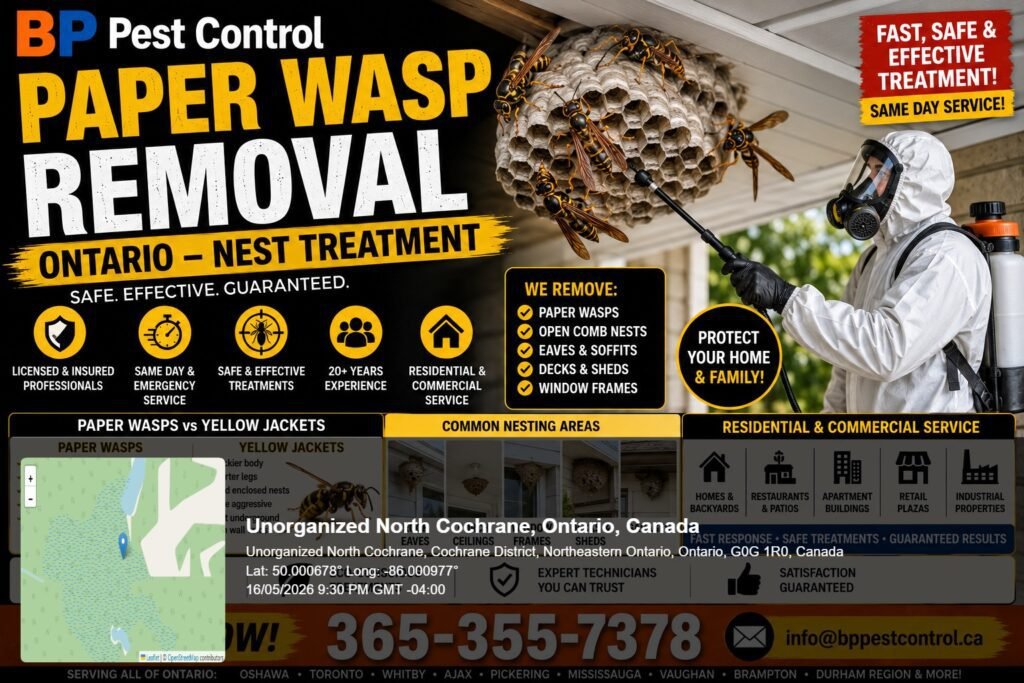
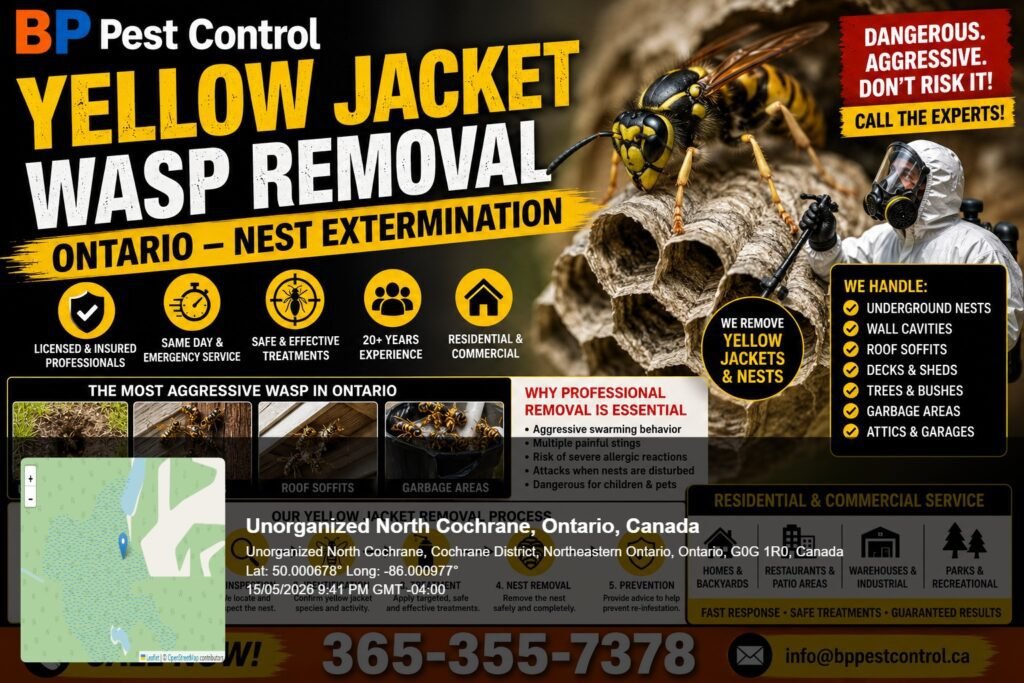
how to identify a wasp nest before it becomes a full-scale infestation is one of the most valuable things an Ontario homeowner can learn. Wasp colonies discovered early — in May or June when they’re still small — are faster, safer, and significantly less expensive to treat than the same colonies in August when they’ve reached peak population and peak aggression. The problem is that the most dangerous wasp nests in Ontario homes are hidden — inside walls, in attics, or underground — where you can’t see them until the colony is already enormous. bp pest control has helped Oshawa, Toronto, Whitby, Ajax, Pickering, Brampton, Vaughan, Mississauga, and Durham Region homeowners identify and eliminate wasp nests for over 20 years. This guide covers exactly how to identify a wasp nest in every common Ontario location — visible and hidden — and when a professional inspection is the only safe next step. Call 365 355 7378 if you suspect an active nest — same-day wasp inspections are available Ontario wide. What Does a Wasp Nest Look Like? The answer depends entirely on the species — Ontario’s three most common wasp species build completely different nests in completely different locations. Knowing what does a wasp nest look like for each species is the starting point for how to identify a wasp nest on your property. Yellow jacket nests: Yellow jackets build enclosed, multi-layered nests from chewed wood fiber mixed with saliva — producing a grey papery material with a characteristic layered appearance. Above-ground yellow jacket nests look like a grey, rounded, papery ball — similar to a crumpled paper bag — with a single entrance hole at the bottom. These nests are almost always concealed inside a structure (wall void, soffit, attic) or underground, which is why they’re rarely visible until the colony is very large. Bald-faced hornet nests: The large, enclosed, oval paper nests commonly seen in trees and on building facades are almost always bald-faced hornets. These nests are distinctively grey, smooth on the exterior, with a pointed lower end and a single entrance hole near the bottom. By late summer, a mature hornet nest can be 30 to 90cm in length. Paper wasp nests: The most visually distinctive and immediately recognizable nest type in Ontario. Paper wasp nests are open — the hexagonal cells are exposed and visible without any outer covering, hanging from a narrow stalk. They look like a small upside-down honeycomb umbrella. Typically found under eaves, on porch ceilings, and on window frames. If you’re trying to understand how to identify a wasp nest on your property, start with what you can see — then use the warning signs below to find the nests you can’t. Contact bp pest control at 365 355 7378 or info@bppestcontrol.ca for a professional wasp inspection Ontario wide. Signs of Wasp Nest in Wall: What to Look and Listen For Signs of wasp nest in wall situations are among the most difficult for Ontario homeowners to detect — and among the most important to catch early. Yellow jackets nesting inside wall voids are the most common interior infestation our technicians treat across Oshawa, Ajax, Pickering, and Toronto every season. The definitive signs of wasp nest in wall activity: Consistent wasp traffic at a specific exterior point: A small gap in your siding, a crack between bricks, a gap around a pipe penetration, or an opening in your soffit where you consistently observe wasps entering and exiting is almost certainly a wall void nest entrance. The traffic is regular, directional, and continuous — workers coming and going throughout the day. Buzzing or vibrating sounds from inside the wall: A yellow jacket colony inside a wall void produces a distinctive buzzing or vibrating sound that can be heard through the wall surface — particularly in a quiet room when you hold your ear to the drywall. This is one of the clearest signs of wasp nest in wall activity. Wasps appearing inside your home: Workers emerging from electrical outlets, around baseboards, or near ceiling light fixtures on the interior side of the affected wall are a definitive sign of an active interior colony. The workers are finding their way through existing gaps in the electrical and plumbing penetrations inside the wall void. Visible staining or bulging of drywall: In advanced cases where a yellow jacket colony has been growing inside a wall void for an extended period, the nest material may press against interior drywall, causing visible bulging. Honey-like staining can also appear as organic material from the nest migrates through drywall. Call bp pest control at 365 355 7378 immediately if you observe signs of wasp nest in wall activity at your Ontario property. Wasp Nest in Roof Ontario: Soffits, Fascia & Rooflines Wasp nest in roof Ontario situations are consistently among the most common residential calls we receive across Durham Region and the GTA every summer. The protected space behind roof soffits — particularly where soffit panels have gapped, warped, or been damaged — is prime yellow jacket nesting territory. How to identify a wasp nest in roof areas of your Ontario home: Wasp traffic at soffit level: Observe your roofline from a safe distance. If you see consistent wasp activity entering or exiting a small gap where the soffit meets the fascia board, along the soffit panel edge, or through a vent opening, a wasp nest in roof or soffit space is almost certainly present. Visible nest material through gaps: In some cases, you can see the grey papery nest material through gaps in damaged soffit panels — particularly in older Oshawa, Whitby, and Toronto homes where soffit panels have shifted over time. Increased late-summer roof activity: Yellow jacket activity at roofline level increases significantly from August onward as colony population peaks. If you’re seeing unusual numbers of wasps at your roofline in late summer, professional inspection is warranted. Wasp nest in roof Ontario treatment requires access to the soffit space and professional-grade treatment — not hardware store aerosols