how to identify a wasp nest before it becomes a full-scale infestation is one of the most valuable things an Ontario homeowner can learn. Wasp colonies discovered early — in May or June when they’re still small — are faster, safer, and significantly less expensive to treat than the same colonies in August when they’ve reached peak population and peak aggression. The problem is that the most dangerous wasp nests in Ontario homes are hidden — inside walls, in attics, or underground — where you can’t see them until the colony is already enormous.
bp pest control has helped Oshawa, Toronto, Whitby, Ajax, Pickering, Brampton, Vaughan, Mississauga, and Durham Region homeowners identify and eliminate wasp nests for over 20 years. This guide covers exactly how to identify a wasp nest in every common Ontario location — visible and hidden — and when a professional inspection is the only safe next step.
Call 365 355 7378 if you suspect an active nest — same-day wasp inspections are available Ontario wide.
What Does a Wasp Nest Look Like?
The answer depends entirely on the species — Ontario’s three most common wasp species build completely different nests in completely different locations. Knowing what does a wasp nest look like for each species is the starting point for how to identify a wasp nest on your property.
Yellow jacket nests: Yellow jackets build enclosed, multi-layered nests from chewed wood fiber mixed with saliva — producing a grey papery material with a characteristic layered appearance. Above-ground yellow jacket nests look like a grey, rounded, papery ball — similar to a crumpled paper bag — with a single entrance hole at the bottom. These nests are almost always concealed inside a structure (wall void, soffit, attic) or underground, which is why they’re rarely visible until the colony is very large.
Bald-faced hornet nests: The large, enclosed, oval paper nests commonly seen in trees and on building facades are almost always bald-faced hornets. These nests are distinctively grey, smooth on the exterior, with a pointed lower end and a single entrance hole near the bottom. By late summer, a mature hornet nest can be 30 to 90cm in length.
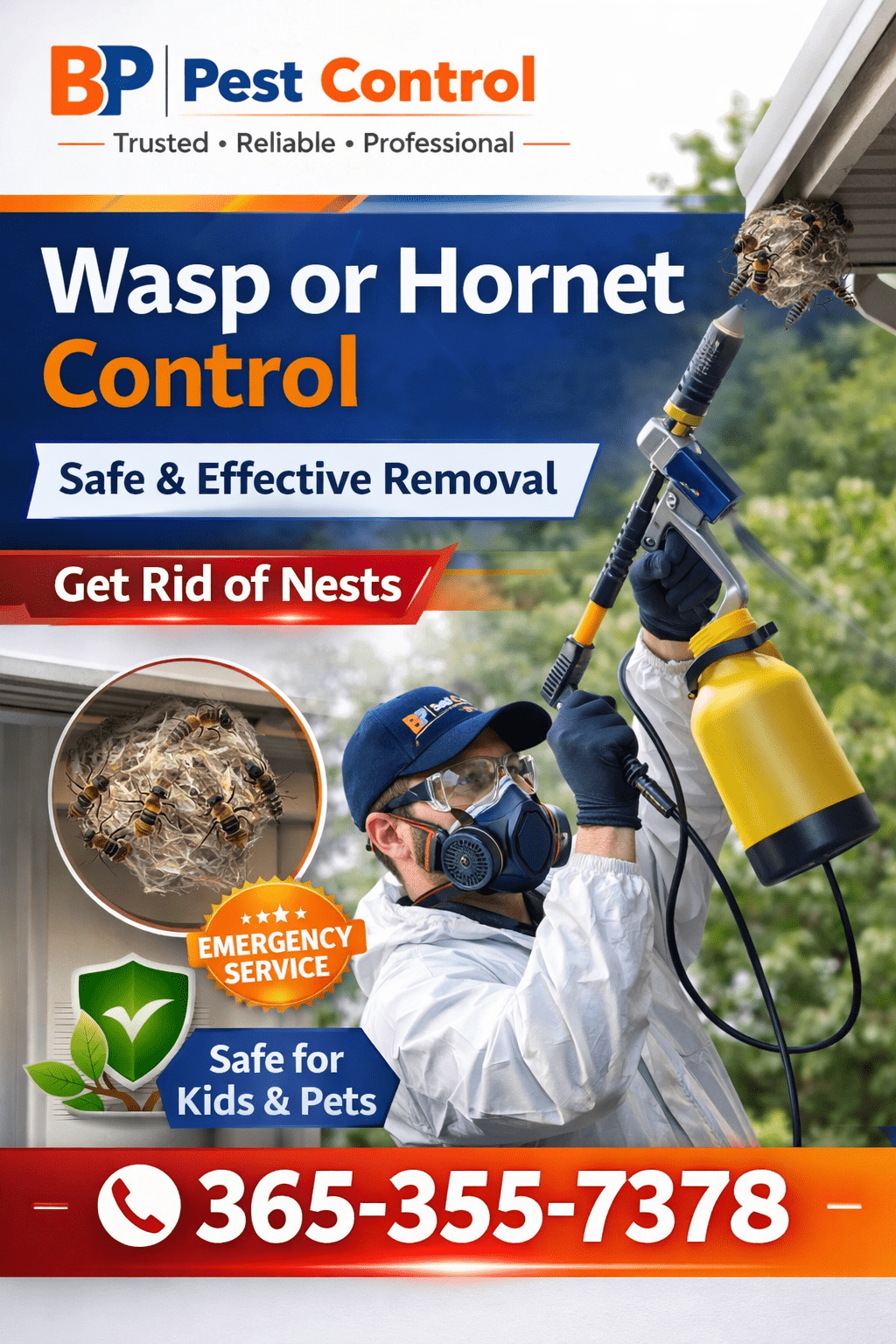
Paper wasp nests: The most visually distinctive and immediately recognizable nest type in Ontario. Paper wasp nests are open — the hexagonal cells are exposed and visible without any outer covering, hanging from a narrow stalk. They look like a small upside-down honeycomb umbrella. Typically found under eaves, on porch ceilings, and on window frames.
If you’re trying to understand how to identify a wasp nest on your property, start with what you can see — then use the warning signs below to find the nests you can’t.
Contact bp pest control at 365 355 7378 or info@bppestcontrol.ca for a professional wasp inspection Ontario wide.
Signs of Wasp Nest in Wall: What to Look and Listen For
Signs of wasp nest in wall situations are among the most difficult for Ontario homeowners to detect — and among the most important to catch early. Yellow jackets nesting inside wall voids are the most common interior infestation our technicians treat across Oshawa, Ajax, Pickering, and Toronto every season.
The definitive signs of wasp nest in wall activity:
Consistent wasp traffic at a specific exterior point: A small gap in your siding, a crack between bricks, a gap around a pipe penetration, or an opening in your soffit where you consistently observe wasps entering and exiting is almost certainly a wall void nest entrance. The traffic is regular, directional, and continuous — workers coming and going throughout the day.
Buzzing or vibrating sounds from inside the wall: A yellow jacket colony inside a wall void produces a distinctive buzzing or vibrating sound that can be heard through the wall surface — particularly in a quiet room when you hold your ear to the drywall. This is one of the clearest signs of wasp nest in wall activity.
Wasps appearing inside your home: Workers emerging from electrical outlets, around baseboards, or near ceiling light fixtures on the interior side of the affected wall are a definitive sign of an active interior colony. The workers are finding their way through existing gaps in the electrical and plumbing penetrations inside the wall void.
Visible staining or bulging of drywall: In advanced cases where a yellow jacket colony has been growing inside a wall void for an extended period, the nest material may press against interior drywall, causing visible bulging. Honey-like staining can also appear as organic material from the nest migrates through drywall.
Call bp pest control at 365 355 7378 immediately if you observe signs of wasp nest in wall activity at your Ontario property.
Wasp Nest in Roof Ontario: Soffits, Fascia & Rooflines
Wasp nest in roof Ontario situations are consistently among the most common residential calls we receive across Durham Region and the GTA every summer. The protected space behind roof soffits — particularly where soffit panels have gapped, warped, or been damaged — is prime yellow jacket nesting territory.
How to identify a wasp nest in roof areas of your Ontario home:
Wasp traffic at soffit level: Observe your roofline from a safe distance. If you see consistent wasp activity entering or exiting a small gap where the soffit meets the fascia board, along the soffit panel edge, or through a vent opening, a wasp nest in roof or soffit space is almost certainly present.
Visible nest material through gaps: In some cases, you can see the grey papery nest material through gaps in damaged soffit panels — particularly in older Oshawa, Whitby, and Toronto homes where soffit panels have shifted over time.
Increased late-summer roof activity: Yellow jacket activity at roofline level increases significantly from August onward as colony population peaks. If you’re seeing unusual numbers of wasps at your roofline in late summer, professional inspection is warranted.
Wasp nest in roof Ontario treatment requires access to the soffit space and professional-grade treatment — not hardware store aerosols applied from a ladder without protective equipment. Call bp pest control at 365 355 7378 for same-day wasp nest in roof inspection Ontario wide.
Wasp Nest in Attic Ontario: Hidden & Dangerous
Wasp nest in attic Ontario situations develop when wasps gain access through ridge vents, gable end vents, or attic access points with damaged or absent screening. The enclosed, protected attic space is ideal for large yellow jacket colony development — and attic nests are almost never discovered until late summer when the colony is very large.
Signs of wasp nest in attic Ontario activity:
Wasps visible around attic vents: Queens scout attic vents in spring looking for access points. If you observe wasp activity near your ridge vent or gable vents — particularly in April and May — an attic inspection before a colony establishes is the best possible outcome.
Wasps in upper-floor rooms: Workers finding their way into upper floor rooms through gaps around ceiling light fixtures, attic hatch seals, or ceiling penetrations indicate an active attic nest above.
Buzzing from above: Audible buzzing from the ceiling of your top floor — particularly at certain times of day — indicates a large colony directly above your living space.
Wasp nest in attic Ontario situations are particularly dangerous to inspect without professional equipment due to the enclosed environment and the difficulty of retreat once a colony is disturbed. Call bp pest control at 365 355 7378 or email info@bppestcontrol.ca for professional wasp nest in attic Ontario inspection.
Underground Wasp Nest Ontario: The Most Dangerous Discovery
Underground wasp nest Ontario situations are consistently the most hazardous residential discovery — because they are almost always found accidentally, at close range, in an outdoor environment with no immediate shelter available.
Yellow jackets build underground colonies in abandoned rodent burrows, under concrete slabs, beneath landscape timbers, and in soil cavities beneath lawn surfaces. The entry point is a small circular hole — typically 2 to 4cm in diameter — that can be easily overlooked in grass or garden mulch until it’s stepped on.
How to identify an underground wasp nest Ontario on your property:
A small hole in the ground with wasp traffic: The clearest identifier. A circular ground-level opening with consistent wasp traffic entering and exiting — particularly in lawn areas, along garden bed edges, or near landscape timbers — is an active underground yellow jacket colony. Observe from at least 5 to 10 metres away.
Unexplained wasp presence near ground level: Wasps flying very low, hovering near a specific ground area, or appearing to land in grass without an obvious reason are often investigating or departing from an underground nest entrance hidden in the vegetation.
Wasps agitated when mowing or gardening: If operating a lawn mower or working in the garden consistently agitates wasps in a specific area of your yard, the vibrations are likely reaching an underground colony below that spot.
Do not approach, dig near, or apply any product to a suspected underground wasp nest Ontario entrance. The defensive swarm from a disturbed underground colony erupts from the ground rapidly in a wide radius. Call bp pest control at 365 355 7378 for same-day underground wasp nest Ontario inspection and treatment.
Wasp Nest in House Wall Ontario: Interior Infestation Warning Signs
Wasp nest in house wall Ontario situations share many characteristics with the general wall void signs above, but in an Ontario residential context there are several additional patterns worth understanding — particularly for older housing stock in Oshawa, Toronto, Pickering, and across Durham Region.
Ontario’s older residential homes — Victorian semis, post-war bungalows, and mid-century detached properties — have decades of accumulated small gaps in their exterior envelope. Weep holes in brick veneer, gaps around original plumbing penetrations, spaces under original wood window trim, and openings around utility entrances all provide easy access to wall cavities.
If you have an older Ontario home and you’re seeing any combination of: wasp traffic at a consistent exterior point, buzzing from a specific wall, or wasps appearing inside through outlets — you almost certainly have a wasp nest in house wall Ontario situation requiring professional treatment.
Contact bp pest control at 365 355 7378 for a professional wasp nest in house wall Ontario inspection today.
How to Identify Yellow Jacket Nests
Yellow jacket nests are the most commonly treated species in Ontario and the most varied in terms of nest location. Here is how to identify a wasp nest specifically for yellow jackets:
Above-ground enclosed nests (in walls, soffits, attics): No visible nest structure from outside. Only indicator is consistent wasp traffic at a small entry gap and potentially buzzing sounds from inside the structure. The nest itself is a grey, multi-layered papery ball inside the cavity — not visible externally.
Underground nests: A small circular ground-level entrance hole with consistent wasp traffic. The nest chamber below may be much larger than the entrance suggests — sometimes the size of a basketball or larger in mature colonies.
Nest material colour: Yellow jacket nest material is typically grey to light tan — the colour of chewed, weathered wood fiber. The layered, corrugated exterior of the enclosed nest is distinctive when seen directly.
Colony size indicator: If you are seeing dozens of workers per minute entering and exiting a nest entrance point in late summer, the colony is large. Early season nests (May-June) show fewer than 10 workers per minute at the entrance.
Call bp pest control at 365 355 7378 for professional yellow jacket nest identification Ontario wide.
How to Identify Hornet Nests
Bald-faced hornet nests are among the most visually distinctive in Ontario — and once you know what to look for, they’re immediately recognizable:
Aerial, enclosed, grey oval: The classic bald-faced hornet nest is a large, enclosed, grey papery structure hanging from a tree branch, building facade, or roofline element. The exterior is smooth and layered, with a slightly pointed lower end and a single entrance opening near the bottom.
Size progression: Early-season hornet nests (June) may be the size of a grapefruit. By August, a mature colony’s nest can reach 60 to 90cm in length — large enough to be clearly visible in a tree from ground level.
Location: Trees are the most common location — particularly in the upper branches where the nest is sheltered by leaves during summer but becomes highly visible once leaves drop in fall. Also found on building facades, under rooflines, and on the structural elements of outdoor structures.
Unique warning sign: Bald-faced hornets are highly territorial. If you consistently find yourself being followed or buzzed aggressively in your Vaughan, Brampton, or Mississauga backyard without a visible nest, look up — the nest may be in a tree above your sightline.
For professional hornet nest removal and identification, call bp pest control at 365 355 7378.
How to Identify Paper Wasp Nests
Paper wasp nests are the easiest of Ontario’s three common species to identify — and fortunately also the most visible:
Open, exposed hexagonal cells: The defining feature. Paper wasp nests have no outer covering — the individual hexagonal cells are visible from below, arranged in a single layer hanging from a narrow stalk. They look like a small, inverted honeycomb.
Hanging attachment: Always suspended from a surface above — never resting on a horizontal surface. Look for them in the corners where eaves meet fascia, on porch ceilings, under deck board overhangs, inside garage door frame corners, and on window frames.
Size range: Paper wasp nests range from the size of a golf ball (early season, 5-10 cells) to 10-15cm in diameter (late season, 100+ cells). Unlike hornet nests, they do not grow particularly large.
Colour: Grey-brown, the colour of natural wood pulp. Slightly lighter when new, darker as the season progresses.
Contact bp pest control at 365 355 7378 for professional paper wasp identification and paper wasp removal Ontario wide.
Dangerous Signs You May Have a Hidden Wasp Nest
These are the warning indicators that a nest is present somewhere on your property even when you cannot locate it visually:
Consistent buzzing from a wall, ceiling, or floor: Any persistent buzzing or vibrating sound coming from inside a structural surface — wall, ceiling, or floor — that you cannot explain indicates an active interior colony.
Wasps entering or exiting a consistent exterior point: Regular, directional wasp traffic at any gap in your home’s exterior envelope — even a gap as small as 6mm — is a definitive nest indicator.
Increased wasp numbers in late summer: If you suddenly notice far more wasps around your property in August than earlier in the season, a colony has been growing somewhere on or near your property through the warmer months.
Wasps appearing inside through electrical fixtures: Emerging from outlets, light switches, or ceiling fixtures is a clear sign of an active wall void or attic nest.
Aggressive wasp behaviour near a specific area: If a particular part of your property consistently produces aggressive wasp encounters — without you being able to identify a visible nest — the colony is likely concealed in that area, underground or within a structure.
Swarming activity near a roofline or tree: Visible swirling groups of wasps near a roofline section or in the canopy of a specific tree indicate a nearby nest being actively defended.
Call bp pest control at 365 355 7378 or email info@bppestcontrol.ca if you’ve observed any of these signs at your Ontario property.
Why DIY Wasp Nest Inspection Can Be Dangerous
Attempting to how to identify a wasp nest yourself by investigating potential nest sites directly — peering into soffit gaps, digging near ground-level holes, examining wall cavities — creates the exact disturbance that triggers a defensive swarm.
Yellow jackets in particular require no direct contact with the nest to mobilize defensively. Vibrations from footsteps near underground nests, shadows passing over concealed soffit nests, or the sound of an approach near a wall void — any of these can trigger a defensive response before you’ve made any direct contact.
Without full professional protective equipment:
- You cannot safely investigate a suspected soffit or roofline nest entrance
- You cannot safely observe an underground nest entrance at close range
- You cannot safely probe or examine a suspected wall void nest from inside your home
- You cannot safely investigate an attic space where a colony may be established
A professional inspection with full protective equipment is the only safe way to confirm a hidden nest location, assess colony size, and determine the appropriate treatment approach.
Call bp pest control at 365 355 7378 for a safe, professional wasp nest identification inspection Ontario wide.
When to Call a Professional Wasp Exterminator
Call a professional immediately if any of the following apply:
- You have observed consistent wasp traffic at a gap in your home’s exterior envelope
- You hear buzzing from inside a wall, ceiling, or attic space
- Wasps are appearing inside your home through outlets or fixtures
- You have found a circular hole in your lawn with wasp activity
- Someone on your property has already been stung without a visible nest
- A household member has a known venom allergy
- You’ve seen a large aerial nest in a tree or on your building
Contact bp pest control at 365 355 7378 or info@bppestcontrol.ca for same-day professional inspection Ontario wide.
The bp pest control Inspection Process
When you contact bp pest control for a wasp nest identification inspection, here is exactly what happens:
Step 1 — Full property inspection: Our licensed technician arrives in full protective equipment and conducts a systematic inspection of your entire property — every section of the exterior envelope, all roofline elements, the attic if accessible, all outbuildings, fences, trees, and the full lawn perimeter for ground-level nest indicators.
Step 2 — Species identification: Based on nest structure, wasp appearance, flight patterns, and activity characteristics, we confirm the species before any treatment decision. Different species require entirely different treatment approaches.
Step 3 — Nest location detection: For hidden nests — wall voids, attic nests, underground colonies — we use our inspection findings and professional experience to determine the precise nest location before treatment. Treating the wrong location is ineffective; we locate the colony accurately first.
Step 4 — Treatment recommendations: Based on the species identified and the nest location confirmed, we recommend the appropriate treatment protocol — explaining what products will be used, how they work, what access is required, and what results you can expect.
Step 5 — Prevention strategies: Before leaving, we provide specific, property-tailored prevention recommendations — sealing identified entry points, addressing conditions that attracted the nesting queen, and advising on early-spring monitoring that catches the next season’s activity before it establishes.
Call bp pest control at 365 355 7378 to book your professional wasp inspection today.
Residential Wasp Inspections Ontario
bp pest control provides comprehensive residential wasp nest inspection services Ontario wide — covering all home types and all nest configurations across our full service area.
Whether you’re in an older Oshawa semi-detached with years of accumulated soffit entry points, a newer Brampton subdivision build with fresh construction gaps, a Toronto Victorian heritage property with original exterior features, or a rural Durham Region property with large lots and outbuildings — our technicians are experienced with the specific inspection challenges each home type presents.
Same-day residential wasp inspections are available across all service areas. Call 365 355 7378 to book.
Commercial Wasp Inspections Ontario
Commercial wasp inspections Ontario wide from bp pest control serve restaurants, warehouses, retail plazas, apartment buildings, office buildings, schools, and any other commercial property type across our service area.
Commercial inspections include written service documentation suitable for OHSA compliance records and property management reports. We work around your operational schedule and provide detailed findings and treatment recommendations in written form.
For commercial wasp nest identification inspections, contact bp pest control at 365 355 7378 or info@bppestcontrol.ca.
Why Choose bp pest control for Wasp Nest Identification in Ontario?
20+ years of Ontario wasp inspection experience: Two decades inspecting and treating wasp nests across every community type in Ontario — urban, suburban, and rural. We have identified hidden nests in wall voids, attics, underground, and in every other concealed location Ontario properties present. That depth of experience is irreplaceable when it comes to finding nests that aren’t visible.
Fully licensed under Ontario Regulation 914: Every technician holds a valid Ontario Exterminator Licence and operates in full compliance with the Ministry of the Environment, Conservation and Parks. Our inspections and treatments meet all provincial standards.
Same-day inspection availability: We offer same-day wasp nest identification inspections across our Ontario service area — Oshawa, Whitby, Ajax, Pickering, Toronto, Brampton, Mississauga, Vaughan, and all of Durham Region.
Full protective equipment on every inspection: We never inspect active nest areas without full professional protective gear. Your safety and our technicians’ safety are equally non-negotiable.
Transparent findings and recommendations: After every inspection, we provide a clear explanation of what we found, where the nest is, what species is involved, and what treatment approach is recommended — before any work begins.
Our 5-star reviews from Oshawa and Durham Region clients and 5-star reviews from Toronto and GTA clients reflect the professional standard we maintain on every inspection call.
📞 Call 365 355 7378 📧 Email info@bppestcontrol.ca 🌐 Visit bppestcontrol.ca
Areas We Serve Across Ontario
bp pest control provides wasp nest identification inspections across our full service area:
Oshawa and Durham Region: Home base — same-day inspections across all Oshawa neighbourhoods and all Durham Region communities including Whitby, Ajax, Pickering, Clarington, and Bowmanville.
Toronto: All boroughs — Scarborough, Etobicoke, North York, East York, and downtown Toronto.
Brampton: All Brampton communities with same-day availability.
Mississauga: Full Mississauga coverage from Port Credit to Meadowvale.
Vaughan: All Vaughan communities including Woodbridge, Maple, and Kleinburg.
Call 365 355 7378 to confirm same-day inspection availability at your specific Ontario address.
Preventing Future Wasp Infestations
Once your current nest is identified and treated, here is how to reduce the likelihood of needing another wasp nest identification inspection next season:
Conduct your own visual inspection of all exterior surfaces each April — eaves, soffit edges, porch ceilings, window frames, deck structures, and fence lines. Early discovery of a small new nest is far better than the late-summer alternative.
Seal every exterior entry point identified in your current inspection. Gaps in soffit panels, around pipe penetrations, at window frame edges, and in foundation areas all provide next season’s queens with the same access points this season’s colony used.
Replace damaged vent screening promptly. Attic ridge vents and gable end vents with missing or deteriorated screen are consistently among the most common entry points our technicians identify in Ontario wasp inspections.
Book a proactive early-season inspection each spring. Catching activity in May means treating a small, early-stage colony — not a massive late-summer infestation. Call 365 355 7378 to schedule a spring inspection appointment.
Conclusion: Don’t Wait Until a Sting Incident to Find Your Wasp Nest
Knowing how to identify a wasp nest in your Ontario home is genuinely valuable — but knowing when to hand the inspection off to a professional is equally important. Hidden nests in walls, attics, and underground require professional detection and professional treatment. Investigating them yourself without protective equipment creates the emergency you’re trying to prevent.
bp pest control brings 20+ years of Ontario wasp nest identification expertise to every inspection call — with licensed technicians, full protective equipment, and the local knowledge to find hidden nests in every property type across Oshawa, Toronto, Brampton, Mississauga, Vaughan, and Durham Region.
Our 5-star reviews from Oshawa and Durham Region clients and 5-star reviews from Toronto and GTA clients reflect the expertise we deliver on every wasp nest identification inspection across Ontario.
📞 Call 365 355 7378 — same-day wasp inspections available Ontario wide 📧 Email info@bppestcontrol.ca — describe what you’re seeing and we respond fast 🌐 Visit bppestcontrol.ca — learn about our full wasp removal services
bp pest control. Licensed. Local. Ontario’s trusted wasp nest identification experts for over 20 years.
Frequently Asked Questions: How to Identify a Wasp Nest
1. How do I know if I have a wasp nest in my wall?
The clearest signs of how to identify a wasp nest in a wall are: consistent wasp traffic entering and exiting a small gap in your exterior siding or soffit; a buzzing or vibrating sound audible through the wall surface in a quiet room; and wasps appearing inside your home through electrical outlets, around baseboards, or near ceiling fixtures. Any one of these signs warrants a professional inspection. A yellow jacket colony inside an Ontario wall void can grow to thousands of workers through summer without ever producing a clearly visible external nest structure. Call bp pest control at 365 355 7378.
2. What does a wasp nest look like inside a wall?
A wasp nest inside a wall in an Ontario home is almost always built by yellow jackets. The nest itself is a grey, multi-layered papery structure made from chewed wood fiber — similar in appearance to a crumpled paper bag with distinct horizontal layers. It fills the available wall cavity space as the colony grows, potentially reaching the size of a basketball or larger in mature late-summer colonies. The nest is never visible from outside — only the workers entering and exiting the entry gap and the buzzing sounds through the wall indicate its presence. Call 365 355 7378 for professional inspection.
3. How do I find an underground wasp nest on my Ontario property?
Underground wasp nest Ontario identification starts with observing your lawn from a safe distance of at least 5 to 10 metres. Look for a small circular hole — typically 2 to 4cm in diameter — in your lawn, along garden bed edges, or near landscape timbers, with consistent wasp traffic entering and exiting at ground level. Wasps flying very low near a specific area, or aggressive encounters when mowing or gardening in a particular spot, also indicate an underground colony below that location. Never approach or probe a suspected underground nest entrance. Call bp pest control at 365 355 7378 immediately.
4. What does a wasp nest in the attic look like?
A wasp nest in an attic Ontario situation is almost always a yellow jacket colony that entered through a gable vent, ridge vent, or attic access gap with damaged or absent screening. The nest itself — if visible — is a grey, multi-layered papery ball built on attic framing, insulation, or structural elements. Signs of how to identify wasp nest in attic situations include: wasp activity around attic vents, buzzing from the ceiling of your top floor, and wasps appearing in upper-floor rooms through ceiling fixtures. Attic nest inspection requires professional equipment. Call 365 355 7378 for a safe inspection.
5. How do I identify a wasp nest vs a bee nest?
The key differences for how to identify a wasp nest versus a bee nest: paper wasp nests have an open, exposed honeycomb structure hanging from a stalk — if you can see the individual hexagonal cells, it is a paper wasp nest, not a bee nest. Yellow jacket nests are enclosed in grey papery material and concealed inside structures. Bee nests — honeybees specifically — are made of wax honeycomb and have a distinctly different yellowish, wax appearance. Bumblebee ground nests are in burrows and contain small waxy cells mixed with pollen. If you’re unsure, call bp pest control at 365 355 7378 for professional species identification.
6. How do you identify a paper wasp nest?
A paper wasp nest is the most visually distinctive and easiest of Ontario’s common wasp species to identify. It is an open-cell structure — the individual hexagonal cells are clearly visible without any outer covering — hanging from a narrow central stalk attached to the surface above. The nest looks like a small upside-down honeycomb umbrella, typically grey-brown in colour. Paper wasp nests are found under eaves, on porch ceilings, inside garage door frame corners, on window frames, and under deck boards across Ontario properties. Unlike yellow jacket nests, paper wasp nests are almost always visible and accessible. Call 365 355 7378 for removal.
7. How do you identify a hornet nest in Ontario?
A bald-faced hornet nest in Ontario is an enclosed, oval to teardrop-shaped papery structure hanging from a tree branch, building facade, or structural element. The exterior is smooth and grey, with distinct horizontal layers visible on the surface and a single entrance hole near the pointed lower end. Early-season hornet nests are grapefruit-sized; mature late-summer nests can reach 60 to 90cm in length. They are most commonly found in the upper branches of trees where they’re hidden by leaves in summer — becoming clearly visible once leaves fall in autumn. Call bp pest control at 365 355 7378 for professional hornet nest identification.
8. What are the signs of a wasp nest in the roof of my Ontario home?
Signs of wasp nest in roof Ontario situations include: consistent wasp traffic at a soffit panel gap, damaged vent opening, or space where the soffit meets the fascia board; visible nest material visible through gaps in damaged soffit panels; and increased wasp activity at roofline level in late summer. A wasp nest in roof or soffit space in an Ontario home is almost always a yellow jacket colony that entered through a gap in the soffit system. The nest grows through summer inside the protected soffit cavity. Professional inspection from a licensed technician is the safe way to confirm and treat. Call 365 355 7378.
9. Is it safe to inspect a wasp nest myself in Ontario?
Visual observation from a safe distance of 5 to 10 metres or more is generally safe — but approaching, probing, or investigating any suspected nest location closely is not safe without full professional protective equipment. Yellow jackets in particular will mobilize defensively in response to vibrations, shadows, and approach — before any direct contact is made. Underground nests and wall void nests cannot be safely investigated by an unprotected homeowner. The most important part of how to identify a wasp nest is knowing when to stop and call a professional. Call bp pest control at 365 355 7378 for a safe professional inspection.
10. When is the best time to identify and treat a wasp nest in Ontario?
The best time for how to identify a wasp nest and arrange treatment in Ontario is as early in the season as possible — May through June when colonies are small and queen populations are limited. Early-season nests require less product, produce fewer workers during inspection, and create less defensive risk during treatment. August and September nests at peak population require more intensive treatment and carry significantly higher risk of mass stinging events during inspection. If you suspect a nest at any point in the season, call bp pest control at 365 355 7378 immediately — early identification always produces the best outcome.